Appendix 7 From:
Heart of the Living God:
Love, Free Will, Foreknowledge, Heaven:
a Theology on the Treasure of Love
(AuthorHouse, 2004; 707p.): 565-581; Home: www.PreciousHeart.net
A. My
History with Paige Patterson
1. Patterson’s Rejection of Me & Question of ETS Integrity
2. Patterson a Commander in the Theological Trade Winds
3. Why This Challenge to Patterson
4. Patterson a Legend in His Own Time
5. Patterson a Father-figure & My Own Transference
6. Patterson, Open Theism, Love, and My Conscience
7. Patterson’s Letter vis-à-vis the ETS Documents
B. I Challenge Paige Patterson—Gulp!—Heave
to & Come About
1. Patterson and ETS Confusion
2. Patterson’s Troubled
Triumphant Church & Other Deficits
3. Clay Feet and Leadership … Yet Honor Demands Something
4. The Challenge—Gulp!—Heave To & Come About on Genuineness
P.S.:
Return to the Scriptures a Good Idea
See Patterson
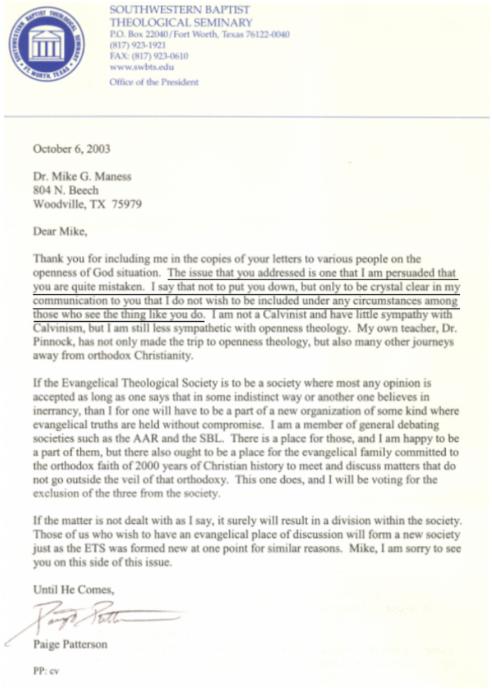
Letter Oct. 6, 2003
I sent Patterson copies of the
original appendices 3-5 on the Evangelical Theological Society (ETS)
controversy, indicating preparation for this book, and he responded:
Thank you for including me in the
copies of your letters to various people on the openness of God situation. The
issue that you addressed is one that I am persuaded that you are quite
mistaken. I say that not to put you down, but only to be crystal clear in my
communication to you that I do not wish to be included under any circumstances
among those who see the thing like you do. I am not a Calvinist and have little
sympathy with Calvinism, but I am still less sympathetic with openness
theology.
If the Evangelical Theological
Society is to be a society where most any opinion is accepted as long as one
says that in some indistinct way or another one believes in inerrancy, than I
for one will have to be a part of a new organization of some kind where
evangelical truths are held without compromise. I am a member of general
debating societies such as the AAR and the SBL. There is a place for those, and
I am happy to be a part of them, but there also ought to be a place for the
evangelical family committed to the orthodox faith of 2000 years of Christian
history to meet and discuss matters that do not go outside the veil of that
orthodoxy. This one does, and I will be voting for the exclusion of the three
from the society.
If the matter is not dealt with
as I say, it surely will result in a division within the society. Those of us
who wish to have an evangelical place of discussion will form a new society
just as the ETS was formed new at one point for similar reasons.
Mike, I am sorry to see you on
this side of the issue.[1]
[see Patterson
Letter Oct. 6, 2003]
A clear and direct answer. A sad
day for me. To take this stand, I burn a bridge behind as I move forward with
my convictions and with a prayer for clarity.
Yet in the context of the ETS
controversy on Open Theism and in the ongoing SBC struggles, Patterson’s words
state a conviction of anathema common among many high-ranking religious leaders
towards Open Theism in general. Though the words are not a big deal in most
theological venues, certainly not even news worthy to the secular world, those
three bold sentences reflect the views of many scholars to some extent. Yet in
the light of the essence of the three counterpoint documents (original
appendices 3-5) sent, the remains of those appendices here, the larger history
of Classical Theism in general, the recent histories of the ETS, the SBC, the
BGCT, the TBC, the SBTC,[2] and now Patterson’s arrival in Texas as President of the mighty
Southwestern Baptist Theological Seminary (SWBTS) in Fort Worth, Texas (with
his roots in Texas)—Patterson has come home at the height of his career. Herein
those words, most likely spoken rather nonchalantly yet most seriously to a
wee-little-former student, do give a clear indication of the direction of where
his mighty influence will plow forward. There is not much room for doubt or
discussion there.
I don’t like it, think he is
mistaken, and shall attempt to challenge him here.
Those who know Paige Patterson
and where he has been in the last twenty years also know that he is a leader
like few in this century. There is a larger story about the rejection and the
question of the ETS, and those words certainly reflect the earthquake fears so
apparent in several of the works reviewed in the appendices above.
I lost much sleep over whether or
not to include this appendix here. As a commentary on a few sentences, it will
be construed by some as a classic piece of defensive dribble and construed by
others as making a mountain out of a mole hill (doubtlessly so for those who do
not know Patterson’s influence and so for those unaware of the ETS or the
ramifications of the free-will/foreknowledge struggles). Many allied with
Patterson with anything close to my own adulation years ago will see this piece
casting shadows on this book’s integrity and on my own integrity, sadly,
because those faithful to Patterson are certainly convinced he has been a
servant mightily used by God. Like David and his mighty men, without a word
from Patterson, a grasshopper cannot tarnish the image of such a mighty
servant.
Many times, God has used Paige
Patterson. In my life to be sure.
So if Patterson is right, truly
appertaining the leading of God on these issues (though his own letter indicates
he has not even read well the material), and I am mistaken as he says about the
appendices 3-5, then please, by God in heaven, show me my error. God cannot be
leading two people in opposite directions on how He Himself has a genuine
loving relationship with us. If God is truly leading Patterson and I am
mistaken, then how about accepting the challenge outlined here and contribute
something substantial on this issue? How about an open debate with champions?
If I am led of God and it took this amount of work for Patterson to see some of
the truth of this, then how about a handshake?
This book is about challenging
Classical Theism, and Patterson is one to the bone.
Leighton Paige Patterson is in a
league quite apart from most all of the authors in this book, including most of
the 2,000 authors in the bibliography. How does Patterson stand out? Like Billy
Graham and Bill Bright in evangelism, like Chuck Swindoll and Max Lucado in
discipleship, like Zig Ziglar in motivation, like Chuck Colson
in prison ministry, and like James Dobson in family affairs, Patterson stands
out on a national scale not as a household name, yet far more subtly as a
credible theological authority of the first order for many Classical Theists
(especially non-Calvinists). And in the SBC, there is no one with his clout at
all. Paige Patterson has been the heartbeat and tactician and in many respects
the political and theological commander of the SBC’s takeover or reformation (depending on who you talk to). Though all of those
nearly household names just mentioned have had influence at the highest levels
of their religious denominations, the distinction of Paige Patterson is that
none of them have had the ear of so many across such a broad field of the top
religious leaders as Patterson, and this is doubly so in the SBC where no
single person has ever had the influence he now enjoys with the majority (and
likewise where no single person or SBC past president has had as large of a
minority outside of his camp to whom he has as little inclination to be
beholden to).
One of the reasons for
Patterson’s SBC influence is his magnetism and gift for networking. Truly a
leader, yet in many respects and with most all of the current hundreds of
leaders throughout the SBC, Patterson has given a shepherd’s heart with the
courage of a lion. Patterson has charted the way through some tumultuous
waters.
Said in another way, anywhere
that Paige Patterson goes the wakes of his influence wash ashore and turn over
sand. The ripples of his influence permeate all of the SBC and reach many of
the outer reaches of the SBC and beyond and into in the Classical Theist
oceans, even heading upstream in the deltas of other denominations. For those
who have been around and tuned to some of the currents, we all know that there
are whales in tow as Patterson’s mighty ship of influence plies the theological
trade winds of America. Patterson carries the demeanor of good pastor well, but
he is also the ranking and veteran commander with proven leadership and a
mighty army about him.
For many thousands, Patterson is
a commander-in-chief with a shepherd’s heart, the wisdom of the ages, the
strength of a lion, and the integrity of Nathaniel.
What of those words of rejection
of appendices 3-5 (the originals) and the question of the ETS’s integrity? I
should not take them personal, but I do. They do give me a foothold to
challenge, however effective the challenge may turn out, for though the words
be few in number they do come from a mighty man of God who has exhibited a
level of leadership and stamina like few in the history of the church. I have
no doubt as to Patterson’s sincerity—none whatsoever. Patterson sincerely
believed me to be in error and believed the integrity of the ETS is folding
with a toleration of Pinnock and Sanders. Moreover, as the story below unfolds,
and unlike few men today in the entire country and unlike any at all in the SBC
(the largest Protestant denomination in the country), as the new President of
the largest seminary in the world, Patterson will continue bold rejections
until persuaded otherwise.
Certainly Patterson’s rejection
and my own honor, but truly a fear for the ETS as well. Patterson’s influence
is too formidable to ignore his question of the ETS’s integrity, as the ETS did
support Pinnock contrary to his wishes and did not move to oust Pinnock and
Sanders contrary to his wishes.[3] The largest reason for this appendix is Patterson’s formidable
influence on Classical Theism itself and his own lack of initiative to clarify
his persuasion any better. I defend my honor here, surely I do, but I shall
indicate the need for Patterson’s clarification, and challenge him too, to
heave to and come about on genuineness.
It is one thing to be an
formidable leader in history’s largest Protestant denomination, the SBC, and it
is another thing to exert influence upon perhaps the best Christian scholarly
theological society in church history—the ETS—without so much as a scintilla of
theological contribution, much less open participation in that society’s
discussions.
And given the history to date,
wherever Patterson turns his own mighty gunship, wherever his own
ship-of-the-line barkentine turns, many more in his armada will follow suite
and there will be whales in tow. Perhaps no other single person in the history
of the ETS has such a capacity for division (or healing contribution) within
the ETS as Patterson.
Even though I severely take Roger
Nicole to task in appendix 3 (even
vehemently in the original), I do say it was honorable of Nicole and the ETS
committee to have given the time they did to Pinnock and Sanders in the ETS. As
an ETS charter member, clearly Roger Nicole has been unafraid to participate
regularly in the ETS.[4] Even here I shall defend Nicole’s right challenge Pinnock and Sanders
in open debate. Would that Patterson would be so honorable as well? Rather than
contribute little to nothing in the debates, Patterson would foster
fragmentation within the ETS from the far-flung cabin of his mighty gunship.
One thing is clear, there has
hardly been a more influential person in the history of the Southern Baptist
Convention (SBC) than Leighton Paige Patterson.[5] Unlike E. Y. Mullins in SBC theological restatement
and support of soul freedom and George W. Truett who was one of the most
influential in unifying, Patterson has been most influential in a leadership
role that has galvanized a majority of the SBC against a nearly invisible
minority, and in that galvanizing has helped divide the ranks of the SBC more
than any other single person in the SBC’s history (perhaps in numbers, more
than in any other Christian denomination or entity in the history of the church
in any given two decades in 2,000 years, perhaps even more than Luther in the
reformation, except Luther was not trying to oust so many). And the galvanizing continues in Texas.
We would highlight the work of
the master theologian and pacesetter E. Y. Mullins as one of the original
fundamentalists, a person Harold Bloom said recently was the “Calvin or Luther or Wesley of the Southern Baptists …
pragmatically he is more important than Jonathan Edwards, Horace Bushnell, and the Niebuhrs, because Mullins reformulated (perhaps first
formulated) the faith of the a major denomination.”[6] Mullins was perhaps one of the most productive and original thinkers
among the small and elite core of Southern Baptist seminary presidents.[7] For history’s sake, Bloom would have done well to have at least
referenced the seminal history of Southern Baptists by Robert Baker, and Baker notes the history of fundamentalism when it was a good thing
to be called such, when in opposition to liberal theologians:
Two wealthy laymen financed the
publication of twelve small volumes or pamphlets untitled The Fundamentals: A Testimony of the Truth. These pamphlets brought the name “Fundamentalists” to those holding to
such views and asserted the five basic doctrines that characterized the
Fundamentalist movement: the virgin birth, the bodily resurrection of Christ
and his followers, the verbal inspiration of the Scriptures, and the
substitutionary theory of the atonement, and the imminent, physical second
coming of Christ in the millennial reign. Some of the contributors to this
series were Southern Baptists, including Professors J. J. Reeve and C. B. Williams of Southwestern Baptist
Theological Seminary, and E. Y. Mullins, president of Southern Baptist
Theological Seminary…. The World’s Christian Fundamentals Association was formed
in 1919 with members from Presbyterians, Methodists, Disciples, and Baptists
included in their number.[8]
What is important to note here is
that Patterson is clearly a leader of the SBC, very clear threats exist
regarding the respectibility of Christian witness (like Bloom’s work above),
and the SBC is looking to even move out of the Baptist World Alliance at the
beginning of the 21st century. That is hard to bear itself. Added to that is
the sloppy work by some evangelicals as noted in the appendices against others
like Pinnock and Boyd who are truly believers whose integrity (even Millard
Erickson recognized) is being questioned
by some with very poor argumentation; such low-level humming gives credence to
Bloom’s criticisms when he says of Southern Baptists:
The priesthood of the believer is being replaced by a hierarchy
that will be at once more dogmatic and less intellectualized than the structure
of authority in the Roman Catholic Church.[9]
Truly, reading Bloom is hard for a Christian who
cherishes a living faith and walk with the living God: Bloom does not walk with
God. There is much that could be said about Bloom’s work, including a lot of
negative criticism with respect to Christian
truth, but at least he is clear and his rhetoric is powerful. He clearly
laments the Christian right and defends that,
Only a Gnostic reading of the
Bible can make us into the land of Promise. The new irony of American history
is that we fight now to make the world safe for Gnosticism, our sense of
religion.[10]
OK—and Bloom’s books have been
national best sellers and Bloom is the Sterling Professor for Humanities at
Yale, the Berg Professor of English at New York University, a MacArthur Fellow,
a member of the Institute of Arts and Letters, and has been acclaimed as one of
America’s most distinguished literary critics. Bloom is an admitted “unbelieving Jew
of strong Gnostic tendencies, and a literary critic by profession,” and his
book in many ways rakes much religion as he attempts to define American Religion.[11] His powerful, experienced, critical, and erudite voice and wide
audience make him somebody far more threatening to Classical Theists than
Pinnock and Sanders’ works to be sure. Strange as it may seem, even Bloom
recognized the importance of the priesthood of the believer to Southern
Baptists, though he hardly has an accurate understanding of the dynamics of the
faith as—truly—no one can who is actually not in the faith. When one looks at Bloom’s work side by side with
L. Russ Bush’s The Advancement, a
cry of “uncle” is appropriate or a tap on the mat, for Bush’s loose
confederation of rationales gives credence to Bloom’s complaints about the substance
of Christian academia.
What of the nature of our genuine
relationship with God inside of Classical Theism’s settled future? Patterson
would forward a division of the ETS and a parting from the Baptist World
Alliance into a more myopic version of
Baptist life rather than lead us with some substantial theological
contributions—like Mullins did a century earlier—that clearly articulate the
rationale and biblical validity beyond just the claim of such. Even Mullins’ Axioms of the Religion was helped
into resurrection by Albert Mohler with the help of Timothy and
Denise George in 1997 and published by
Broadman.[12] Few there will be who will notice that the direction of Mohler and
Patterson today is different than that of Mullins in 1908 in several subtle
ways: mainly in two ways, (1) Mullins gave us the substance of his leadership,
and Mohler would like to carry forth the axioms in support of his hierarchy more
than the very spirit of and true essence of the axioms themselves; (2) the true
respect for more differences in the body of believers vis-à-vis the priesthood
of the believer and a more united front against the real threats of
secularization. As I shall argue here, it would be nice if Patterson (Mohler
too) would at least try to
contribute something substantial today where it really matters, something in
the league of Mullins’ own Freedom and
Authority in Religion within the context of the SBC takeover. What about the issue of
genuineness that they both claim exists inside of their view of a settled
future? Some very disrespectful things have been said of Clark Pinnock
(Patterson’s former teacher), and yet little substance makes print.[13]
It is good Christian honor to
support one’s leadership with clear theology.
The real miracle and majesty of
Patterson’s extraordinary leadership is that Patterson has led and is leading
the SBC down another
theological restatement without having contributed a single book justifying the
direction, clarifying the real nature of the adversaries (or just who they
are), or articulating the theological end game. That, my friends, is some kind
of majestic leadership (and God’s blessings in some respects too, we would like
to think, for that is not natural). We just cricket forward that some things
have gone amiss, and that Patterson is not inerrant.
Patterson’s caucus has tried to
take over the historic Baptist General Convention of Texas (BGCT, that he grew up in and whose father help build), and Patterson has
supported a new state convention because the BGCT leadership has not followed precisely the SBC leadership, that,
in spite of the BGCT’s continued financial support to the SBC with more money than most all
other state conventions. Cooperation with the SBC is the issue between the two
Texas state conventions, as ironic as it sounds, for the new alternative SBTC
originated, exists, and subsists to support the SBC.
Patterson networked and led the takeover of the SBC, and today he sits in several elite circles as the veritable chairman of the board as the takeover continues. In many respects,
he is a good person, a fine Christian man, husband, father, and son. Yet in the SBC, a takeover was what
happened, a reformation for some, a correction for others, and for some a
sorrowful degradation of soul freedom (the hallmark of Baptist life).
It has not been easy for anyone on any side—that is, except for the incognito
sycophants.
We know there are no public
sycophants: some are not even aware, others just new in the faith and sincere,
some truly riding the coattails, and we shall never truly be able to separate
the wheat from the tares. Nothing new there. We have been warned about trying to separate the
wheat from the tares, yet that is precisely what has been taking place in the takeover, where some good stocks of wheat got pulled up with the—amazingly
enough—tares that were not truly tares
to all; others became bruised reeds under the rubric of a “reformation” that
still has little clarity for the rank and file of precisely what needs reformed. And the takeover is driven from a small and
elite number of folks “who know best”—the heart of which is led by Paige
Patterson.
Some rooting continues. And the
rooting formula remains confidential and unwritten.
Here is my small side of the
issues. I suspect even Patterson would agree that the rooting continues, though
he would prefer another term, though the rooting was justified in his way by
the need for reformation, a sacrifice of some good wheat that was unavoidable,
or collateral damage, or merely the fallout by those whom Paterson (et al) felt
just did not understand the larger issues (like maybe grasshopper here).
Regardless, the takeover did in
a historic fashion root out who was wheat from tares as defined by Patterson
and his leadership, and that is indisputable history. And only those deemed wheat by Patterson’s
elite caucus will hold the top jobs in the SBC institutions, as another
historic precedent unfolds where more students and professors of the private
Criswell College are moved into more positions than from any other single
private institution in any other decade in the history of the Christian church.
Unprecedented favoritism at least.[14] That is just one indication, as faithful service to the SBC itself is
less important than faithful allegiance to the elite caucus.
From the context of this book’s
body and appendices and because of what follows, honor is at stake, even my own
honor. This book would not be complete or a true challenge without this. Gulp! It is a scary and hard thing to do. After my father died in 1982,
Patterson became even more of a father-figure of sorts for me, though it was
more in my own mind to be sure. Since this book began as a defense of my Daddy, even my heavenly Abba,
it’s truly ironic that the book should end with a challenge to such a
father-figure.
Had someone given to me this
piece between 1978-1985, I would have questioned their integrity for
challenging such a hero. Surely, there are some today who follow Patterson as I
did then with unqualified adulation. Clay feet were shielded all around by his
children.
Shortly after the Air Force in
1975, I became a Christian. I audited courses in 1976-77 at Southwestern
Baptist Theological Seminary (SWBTS), and there is a very long story that led to SWBTS in 1977. From 1978
to 1985, I became a student of Patterson at the Criswell College during those very formative
years of his leadership; I earned a B.A. That was my discipleship, as I had not
grown up in a church, and I loved it. I kept in touch, visiting every few years, and we had
corresponded on several items over the past two decades. I have felt obliged to
include him as well as try to resource him from time to time.
I went to SWBTS from 1985 to 1990 and secured an
M.Div. under Russell Dilday’s leadership. Fresh from the Criswell College, I did not find any liberalism there (after 7.5 years at Criswell I was primed). Instead, I found
professors just as dedicated. I was faithful to chapel (as ever) for those five
years, loving it as much as returning to my first Love, and Dilday never once brought the takeover into the chapel. Shortly after 1990, Dilday was fired, and I could not see
the pastoral side of that—not even these years later. I had now
felt—inappropriately to be sure, in all of my transference and all—that in many
respects I was the product of two
fathers on the opposite sides of the political globe: not as much individually
as I would have preferred, but certainly as the progeny of the two schools they
led. I mean 7.5 years in one place, 5 years in the latter—I hardly lived
anything else from 1977 to 1990.
From 1978 to 2004, I was attuned
to both sides of the takeover and the hurt feelings that came
to many in the process. But I was a grasshopper then and am not much more now.
I also became friends with David Currie, the executive director of the Texas Baptists Committed,[15] and I am pained yet again and
feel a bit ashamed for my fear to include his friendship here, as Currie’s name
alone will alienate me further from Patterson and others. Currie’s leadership
unquestionably helped saved many Texas institutions from the takeover, including Baylor University, and Currie has become as much a pirate to Patterson as Patterson is a
pirate to Currie. But a takeover is a
takeover, and it is hardly pirate-like to be the resisting party, most
especially when the prickliness of tares to be culled is most certainly
not clear to all of the wheat in the wheat field. Patterson’s
focus and leadership is clearly formidable, and there does not appear to be any
resolution in sight.
Now Patterson comes to Texas as
President of the SBC’s flagship seminary and largest in the world. Patterson is
commander of a mighty vessel of theological influence, and there are whales in
tow and mighty men on the deck. He has few defeats and a wide ocean and much
more territory to be claimed, doubtlessly all to the glory of our King.[16]
Patterson has made the career of many, and
in the SBC Patterson and the elite core of
his fellowship has caused or been the cause of the truncation of many other
careers during the SBC takeover. Not just
professorships and seminaries and boards either, but throughout the nation many
positions have been culled. Also, while all six SBC seminaries are bastions of
biblical training, everyone must also know that they field the resumes of
graduates to churches and associations throughout the country, and you must
also know that that fielding is not the mere duplication of the resumes on hand
for all comers alike.
We shall have to trust God there.
The takeover was and is politics simple and plain to some, and
for others it is the leading of God. Only God knows the difference. One thing
is clear, the churches will follow their pastors, and the churches are the source of the SBC, from the bottom up, as the SBC exists to support the churches:
yet as clearly, the elite of the SBC control the institutions and the
heads of the institutions, and those of the body of the SBC are forced to trust the elite in
placement. Many a divisive word and speech has been on the phones and on the
per diem paid for by all of the
SBC on both sides: even many millions from the BGCT has supported the
administration overhead and phone bills of top SBC officials who have talked bad
about the BGCT leadership and have supported the new competing SBTC (not a
faithful stewardship by any stretch). Another case in point, see how the
signing of the 2000 Baptist Faith and
Message has now developed into a creed,
something distasteful in SBC life prior to the takeover.[17]
In 1995, I also went on to secure
my terminal degree at the same school Patterson attended, New Orleans Baptist
Theological Seminary (NOBTS). Patterson’s previous influence played a part in that.
My conscience shall only be clear
before God if I lay before you my best effort, and the above and the following
include some of my testimony to these affairs. Though Patterson has not
published much in comparison with the influence he has been so powerfully
exerting, everyone knows (or must know) that Patterson’s influence on Classical
Theism and in opposition to Open Theism has been pervasive, persuasive, and at
times critical for the last 20 years. His undisputed and historic leadership
allow his word to become law at the near utterance in some theological circles (and
sycophants have no position of their own). Except for God, no one will ever
know for sure the full extent of Patterson’s influence on many—good and bad.
Likewise, many have come to know Christ through him and his dynamic
focus on evangelism, and that focus will definitely cover much. It is hard to be too
critical of someone whose heart is devoted to evangelism.
You must know—must know—that whether one follows
all of Open Theism or not (even though there is no full systematic theology yet
to follow), it is very important to know that one of the most central concerns
of Open Theism is how they make Love the essence of God, how they champion the
personal relationship with God, and how others like Frame and Ware have disputed
the primacy of Love to God’s nature. Doubtless, Patterson knows that too, and
so—hear ye, hear ye—Patterson in so many words also said in his letter that he
did not want to be associated with those who forward Love as the quintessence
of God’s Trinitarian nature. Come now.
As of 2003, Paige Patterson had
now become the president of my second alma mater and first Love, Southwestern Baptist Theological Seminary (SWBTS).
Having been around the circuit,
even a grasshopper, I firmly believe that Love is the essence of God, as
defended in several places in this book. Along with what follows, I believe
that Love needs more clarification and even more distinction in our great
theology textbooks. Attacking Love and even choosing to disassociate oneself
from those who champion Love and God’s Love as the core of God’s Trinitarian
personhood will only derange further the
issues and continue to foster the myths that have arisen.
That is not good business and
slays much honor. Grasshopper protests.
Patterson chose not to be
included among those who believe in the genuineness of their relationship with
God without contraption and those who want to take the
basic readings of the Bible as truth. In silence and nonchalance, Patterson also chose to support misrepresentation. Unbelievable. Gulp,
gulp—dare a grasshopper rat on a lion? Honor. You be the judge, for
that was the very essence of the three documents I sent him, the originals of
appendices 3-5.[18]
How dare a grasshopper stow away and
think to question the commander of a great gunship? Inside of
the ETS brouhaha on Open Theism and that
letter to me, it is reasonable for me to see Patterson saying the words above
(or similar) in several venues of his leadership with respect to Pinnock and
others on these very issues. That makes Patterson a party, as he is so well
known and respected and has been one of the (if not the most) potent leader in
the largest Protestant denomination in the United States—the SBC—in the 20th century in distinction in division at the least, or in
leadership over the minority of tares and questioning wheat at best. One thing
is clear, we do know without question, without doubt, that all of the churches and leaders in
Texas are not tares and that there is much wheat in the BGCT churches and
leadership. It is the great burden of Patterson and his caucus to be clear
there, and they have not in the last ten years.
I shall preempt more dishonor of
my book. From my little single-manned single-mast dingy—if I can hold it steady long enough—I shall launch a small preemptive
strike and shoot my musket across the bow of his mighty
100-gun ship-of-the-line barkentine.
Cricket.
I take initiative first, though
the cricket of a grasshopper cannot go far
compared to the likes of a theological and political Titan like Paige
Patterson. Since Patterson chose to dishonor me in not engaging me or at least
giving a thoughtful response, I was then compelled to either let it ride or
give a response. And letting it ride was a great temptation, for when a mouse
nips at the heals of lion—unless the lion just continues to ignore the
itch—the mouse ought to have more than just an ability to nibble.
I chose to respond.
I have endured dishonor quietly.
But I shall defend my honor now, and I shall even preempt more dishonor of this
work. Patterson was clear, is unafraid of controversy; and if he
follows through, he will continue to
disassociate himself from those who champion genuineness and Love as God’s
essence and in nonchalance continue to endorse misrepresentation. The facts
above and below speak for themselves, for this book’s sake, but the history in
the first footnote of this appendix adds a large and complex context.
I challenge Paige Patterson. He should
heave to and come about with respect to his own claim to a genuine relationship with God. We all know he has
one, and he has been critical of those who have articulated the plain sense of
it better than most: like Pinnock in his Most
Moved Mover. Before I give that challenge, I shall and must outline the
context of that challenge, for by all human standards a grasshopper (or mouse)
has no earthly entitlements to challenge or even expect a response from such a
Titan as Paige Patterson. The context
has to include some manner of biblically-based honor and even contain some measure of
good Christian fellowship for any true challenge to become credible.
Here we go…. Gulp!
The three appendices addressed
three sets of misrepresentations in varying degrees. Paige Patterson, was I
truly mistaken? On what was I mistaken?—on exposing the errors or on
questioning rhetorical presentation or on defending Pinnock or on forwarding
fidelity to the text or on pressing for clarity on the meaning of our genuine
relationship with God? Whatever I was
mistaken about, I felt the appendices were clear enough.
I felt Patterson was wrong for
supporting misrepresentation through nonchalance and then doubly so for
disassociation with my exposing of sloppy work in the attempt to clarify
genuineness in our relationship with God. That is dishonorable. Certainly, Patterson agrees that the genuineness of our relationship
with God is important, but he refused to deal with it in a straightforward
manner.
Does a grasshopper have the right to expect a
sincerely thoughtful response? Not as a mere grasshopper all by his lonesome.
But inside of the context, why not
respond?
Was I really mistaken as he said? I did not expect for Patterson to write a long article
correcting those hard-wrought and rather lengthy pieces I sent him—not at all.
For those who know Patterson, there is a respect for his intellect, and his
preaching is extraordinary; he is a leader of men, doubtlessly, carrying
credibility and erudition well. The point is that the documents were not large
for someone of his caliber, and he could have given something substantial even
in a one- or two-page letter (even if he had simply deferred to Frame or Ware, I suspect that this piece would not be here before you today, for my
own simple and selfish reasons to continue my supplication to Patterson and
even perhaps impress him, or for distribution’s sake at least).
Nevertheless, this book was meant
to be a challenge to Classical
Theism. Many know and for those who do not, Patterson is among a small handful
of men on earth today who can move the entire juggernaut of Classical Theism
with some choice words. From all appearances—my 20+ years of experience and his
now seminal letter to me—Patterson seems to hold the line in much the same way
as Ware, Frame, Feinberg, Nicole, Bush have, and many others Classical Theist lights.
Not surprisingly. Yet unlike them, Patterson is a veteran commander of a mighty
ship of influence, almost without twin in the history of the church. And he did
not mind supporting those who wrote inferior work and in silence did not mind
supporting misrepresentation, while at the same time not giving a scintilla of
clarification for the little folks.
My problem—and it is my problem—is this. If Patterson is
led by God here and I am wrong, then I am not on God’s side. I really did some
work here. I truly want to be on God’s side. If I am wrong, please, help me see
where and who is right. If am I right … well then … how about a handshake?
Obviously, even from his letter,
Patterson himself was not fully aware of
all of the ETS issues, like just who was being
subjected to exclusion, and I wager he had not actually read the sub-standard
material of Nicole. Certainly—I pray to God—I very much do sincerely hope (cross my heart
and hope to live) that Patterson has higher expectations of his own students at
SWBTS. I would not have gotten a good grade in just about any class at SWBTS
under Dilday’s leadership if I had submitted Nicole’s corpus to support Nicole’s
purpose—supporting inerrancy as I do—nevertheless, there were expectations for
clearer thought then, and I suspect and
believe some of the standards continue to this day.
In the three appendices sent, I
had sincerely asked for advice on this issue of God’s genuine relationship with his children—open theism
besides—and truly felt that Roger Nichol’s material was substandard and
undercut the genuineness of prayer, that Timothy George’s letter missed the genuineness issue and even construed “seminiscient” in a misrepresentative manner, and that L. Russ Bush’s letter clearly
misrepresented open theism as believing in the absolute openness of the future and used that misrepresentation
as the chief grounds for exclusion.
Even L. Russ Bush was so
honorable as to concede his error. That’s the Christian and manly thing to do, too, even if other stuff
later brimmed up past his corrections. See appendix 5. Excuse me here, but did
you see what has happened? Dishonor was compounded. Did Patterson mean to
disassociate himself from his own former academic vice president’s admitted
error as well? That is not a great stretch. The material was sent at the same
time to both. Bush admitted error later in so many words to the appendix sent
to Bush, and Patterson chose to deride my work as my error; that is, Bush
admitted his letters misconstrued Open Theism, and Patterson chose to support
that misconstrual (did Patterson read Bush’s letters that he supported or the
appendices 3-5 sent that he derided?). Patterson’s treatment of the Bush
material alone was sloppy and dishonorable ostracism no matter how you look
at it. Grievous. Or it betrays something worse, that Patterson had chosen to
disassociate from persons of documents he had not read and from issues he truly
did not understand. There is no clean way out of this, not even for me (unless
I just shut up and let the matter go). How shall the church triumphant here?
Other than a mistaken volley of firepower, where honor would admit a mistake,
it becomes politics at best or something worse. Far
from judgment, that is just the way the history unfolded now documented by his own hand!
If to me as a grasshopper with
some history and union-card sheepskins—who can be pretty pesky about some
things—then how many times has this happened before in the last 20 years of the
takeover? I challenge Patterson to heave to and come about on these issues. Is
there anything more important than the genuineness of our loving relationship
with God?
I believe Paige Patterson was
mistaken and will hold out hope that he will admit this or
provide something more substantial that makes plain sense to the common
Christian soldier. I suspect not, but challenge anyway. I am dishonored.
Personally, between Patterson and
me, and excepting this issue of God’s fixity—the grasshopper that I am—I do not
think we disagree on as much as he thinks. I surely hope there is a way to bridge the gap. But who’s to know?
Patterson makes claims, even about the ETS, but he has not contributed a scintilla. And for a person respected in
many inner circles for theological erudition, who makes good speeches,
Patterson has not contributed much of anything significant for public
consumption; he just has not written much in the last 20+ years—in books or
technical articles.[19]
I remember when his commentary on
1 Corinthians came out, The Troubled
Triumphant Church (1983), and I bought a copy. I
was still a novice student struggling to get by at the Criswell Center for
Biblical Studies of his presidency (then across the street from First Baptist
Church, Dallas). At that time I would have followed Patterson off a cliff as I
followed him downtown Dallas to do street witnessing. As I read his commentary,
not really knowing much, I found it rather good, and it taught me things I did
not know. Heck … back then I was ignorant of many things (still am), as I had
not even read the Bible all the way through.
I was a new Christian (1975)
without a heritage in any church. The Troubled Triumphant
Church was the first
commentary-exposition I bought and read—because
Patterson wrote it. Moreover, because Patterson wrote it and could do no wrong, I just knew that it
had to be the best in the world and that he certainly had gleaned the best resources
in the world in writing it. Also, for the first time, I began to look up
references, for I truly wanted to see who Patterson had thought were the best
commentators. When I did look at the commentaries he had used, I noticed that
he had not written anything truly new, that much more substance lay hidden in
the works of his references, and that many had much more to say and at times
had said it better.
I could not articulate any
misgivings then, for my adulation would not allow me to criticize
my hero. I thought Patterson hung the moon. But I have reflected over the
years. In many ways, after my father died in 1982, Patterson had
become a father-figure, but I could not get close. I did not have the savoir faire or much of
anything else back then. Though ignorant and frustrated, it was a good time for
me as I struggled and studied forward.
Yet, I have reflected these past
years as I continued my education. I asked myself a few questions. In all honestly,
not judging at all, why would one write a commentary that truly did not need to
be written, since he did not add or contribute anything new, especially when
one’s burgeoning fame would distract readers from the sources that were for the
most part better and more thorough commentaries? Moreover, if you are reading a
better commentary, why not try to make the one you are writing more thorough rather than less? Those were just questions I
had, but could hardly articulate back then. Today they remain serious concerns,
especially in the context of this appendix, in the contexts of this entire set
of appendices, in the light of this book, and even inside and outside of the
SBC.
In December of 2003, in the light
of his letter of rejection of my work, I looked up Patterson in version 5 of The Theological Journal Library CD that cataloged an impressive 150 years of Christian technical journals,
including the JETS from 1966-2001 (35 years!)[20]; there were many Pattersons, but I did not find one major article by
Paige Patterson (though his wife appeared in several).[21] Surely I must have missed something. I did find a short review of
Patterson’s The Troubled Triumphant
Church by Charles Stephenson. Interestingly and affirming some of the things I noticed 20 years ago,
Stephenson noticed some of the same problems back then too, only Stephenson was
far more capable than I was then in articulating the problems. Stephenson
questioned Patterson’s short section on background data and questioned
Patterson’s rather loose use of Greek to make some points not well
substantiated. Stephenson observed,
Assumption of desired theological positions apparently is the norm for
Patterson’s writing style…. [gives examples]
And on p. 117, where he [Patterson] discusses the dissolution of a
marriage of two Christians, he states
that Paul and Jesus do not allow a Christian to
remarry even after a divorce because of an unfaithful mate.
In both of these cases the position is stated but not demonstrated. If all of
his assumptions are correct, he does them a
disservice by not giving the evidence.[22]
Seems to me, at least from my
correspondence so far and Patterson’s own lack of significant attempts to
contribute to theology in journals or books over the last twenty years, that
little has changed. Interestingly, Patterson’s commentary has been re-published
(Eugene, OR: Wipf and Stock Pub., 2002). Yet why? Is profit the only reason to
publish a work that is inferior to its sources? Anyway, what is the reason to
republish the same work 20 years later? Certainly popularity will determine much over quality many times,
and politics … well, that too. Yet how can
eclipsing the better work of others help the troubled church triumph in trust, truth,
justice, and the American way?[23]
I agree that the church shall be triumphant, but we
shall not help its troubles by shying away from biblical clarifications or
attempting to ostracize the champions of genuineness and Love. Certainly the
interpretations that require the larger amounts of circumvention are hardly more faithful to the
text—especially within such shoddy trappings as Roger Nicole’s (Hezekiah Letter of appendix 3 above).
Honor should not be allowed to
pass away so easy. That’s a cricket challenge too.
So what, you might ask? I found out
that my hero had clay feet. I am not without my own faults too, and my own
transference did not help me a lot. Doubtlessly, my own transference scrubbed
me in the wrong ways. But it is certainly not the discovery of clay feet that
is the issue. Hey! I could have done much worse than Patterson for a father-figure of sorts. That is my
problem, and my difficulty in pleasing him may have finally forced me to stand
on my own.
Our problem is making clear sense out of genuineness in the light of
Classical Theist dodging, circumnavigation, and even unreasonable ostracism in its attempts to defend genuineness
in the light of fixed foreknowledge. That’s our problem. And Patterson as president of the largest seminary
in the world will continue to be a part of the problem or part of the solution,
as his position and authority and unquestioned leadership will not allow
neutrality—even in silence, his mighty 100-gun barkentine moves forward into the
theological trade winds. This communiqué from the commander’s cabin betrayed
much more than a grasshopper rejection, for Patterson’s armada shall sail forth
even at the expense of the ETS. Besides the stowaways and sycophantic barnacles that always cling to such
vessels, there be whales in tow and ripples all about the
movement of such ships-of-the-line.
And wise commanders are aware … of the ripples and the
whales!
Here I stand, cannot do less.
Heave to and come about on genuineness. I respected
Patterson for too many years to let this pass, and I have roots too deep to
remain silent. Nor have I kept my eyes in the sand since the days of my
unqualified adulation.
Those precise words in his letter
to me (in the esoteric context just outlined) are what has contributed to some
of the trouble in our church universal. It is not proper for my own president of my school (alma mater and SBC[24]) to allow good people to be misrepresented. Nor is it proper that
plain-sense Bible reading is displaced so that the true (?) meaning of the Bible can only be had by the elite in vast circumlocutions that make little sense to the
common Christian soldier.
Patterson is at the helm of his
career, and his word stands as law in public and even as a veritable chairman of the board in many of
the elite circles of the SBC and beyond. That is good for
those who believe, clay feet and all; but for those who would like something we
can sink our teeth into, there is a near absolute dependence upon his mercy.
And grasshopper got none this time out with his cricketing volleys across the
bow if that great ship.
I challenge Paige Patterson to
put together one good article on whatever he believes about how we can have a
genuine relationship with God inside of an absolutely
settled future. Just one! Or better, will Patterson allow himself to come to the stage
on an equal platform with Clark Pinnock on that issue. Pinnock is not getting
any younger, and masters of his caliber are not coming forth in abundance (we
have seen that in these appendices if nothing else).
Our God is alive and still
active. That is the biblical message that becomes hopelessly handicapped within
the settled future of Classical Theism and makes a mockery out our
genuine loving relationship with God. And it profits no one
when we run from the issues as Patterson did, and it hurts when a Titan like Patterson would support
misrepresentation through nonchalance.
I, the grasshopper and mere
prison chaplain, challenge my esteemed teacher and president of my alma mater—that is
also the largest evangelical seminary in the world—Paige Patterson, I challenge
you to concur and apologize or clarify and take us further into biblical
clarity, knowing that just about anything you would write would be published by
just about anyone. That is too grave a responsibility to forego, I say, and I
also pray he does one or the other and does not remain in unpublished—unpublished!—opposition for long.
This is about the genuineness of our relationship to God, and
God has blessed Patterson too much for him to remain outside of the published
realm of theological development on this.
He took a stand in that letter,
and I ask for the juice to make sense of that stand.
I suspect few of the past
presidents of SWBTS have published as little
substance as Patterson, to say nothing of what appears to be a near total
absence in technical journals, especially in the ETS that he valued as unique among
scholarly Christian societies for its evangelical nature. He would help start a
new society to do what the ETS has been doing, though He
himself has not contributed much in 20 years.
This is of the utmost
seriousness. Patterson has now threatened to bring his mighty 100-gun
barkentine about and open the starboard batteries of his enormous influence upon
the ETS itself, a society in which he has contributed so little. Patterson did
not even contribute a letter to the ETS for posting on the web site as other
members and concerned past ETS presidents had done with respect to the issues
surrounding Roger Nicole’s allegations and the issues at hand! He hardly
participated—so it appears to me—on the most miniscule level.
It shall be as he says from the
confines of his commodore’s cabin or else. He would support yet another
division of Christian fellowship rather than fellowship and struggle with those
and among he would divide. My goodness, but that is a mighty high place.
For those who know even a
smattering of the history of the SBC, the divisions of state conventions
throughout the nation, and even the division in Texas between the BGCT and
SBTC—there is hardly a person on earth today other than Patterson with just the
right set of unique abilities (history, credibility, presidential oversight of
the largest seminary,[25] and influential ties across the nation) that is truly capable of
fostering such a division in the ETS.
Patterson has now threatened to fire
upon the ETS without so much as a single contribution—as now testified by his
own hand. God have mercy. In the light of the society’s executive committee’s
unanimous vote and the ETS at large vote for
Pinnock, Patterson’s threat is a dishonorable use of mighty firepower without sending over so much as
a single set of articles of agreement.
Hey there mate … even the pirates
of the Caribbean had a code.
Aye mate, tis a bit too much rum in hold here. And we know that all
that Patterson has to do is express the desire to support such, and many a
hungry sycophant-pirate-wanna-be will do the rest. Unfortunately,
this is not the Caribbean, and the best of the ETS shall not be intimidated.
And Texas contains some pretty stout stock too.
Heave to and come about on genuineness. This is about
honor, even for grasshoppers, and about honorable rules of engagement.
Patterson is a significant part of
the problem as are many of the other notables in this book. Like a few of the
top contributors here, Patterson could be a part of the progress
towards a solution. If he will.
I challenge Patterson to bring
forth something substantial. If not, at least could he reference someone who
has already spoken his position well on these issues? After 20 years, Patterson
could be creative and give his mature thoughts on genuineness and the dynamism
of Love in the light of his exhaustive-settled foreknowledge. That is not to
much for a distant son in the faith to ask of his old pop. If that
person is in this book, could Patterson then expand upon my adulations, criticisms, misrepresentations, or mistakes and make a substantial contribution to theology? Would
he concur with anyone in this
book? Who?
It’s time for Patterson give us something substantial in print. In
the light of the SBC and ETS controversies—historic the both of them—is there a better issue than the
genuineness of our relationship with God in the light of a somewhat open future
or in the light of a settled future in God’s foreknowledge? This is doubly
apropos in that Patterson is a master and commander of the theological trade winds, even president of the SBC’s flagship seminary—SWBTS, the largest seminary in the world—as well as one in vocal opposition
to those little people and grasshoppers who have
trouble seeing integrity in a genuine relationship that
is also in the context of a fixed-settled future in the mind of God. What is
Love?
We’ve heard the talk. From a
dingy bouncing in the theological trade winds, a grasshopper has fired a
cricketing echo across the bow of Commander Patterson’s juggernaut. The
commander has nothing to lose in ignoring. Grasshopper has risked all in his
musket-cricket volley and loses if grasshopper be ignored or if grasshopper is
fired upon with a thoughtless (or politically targeted) broadside from the
mighty gunship.
Will honor be served?
Grasshopper stands up in his
dingy and casts this gauntlet down.
I remember one of the fireside
chats Patterson was accustom to giving
us in the Criswell College chapel in the 1980’s. He opened
himself up to all questions. One time, he lamented the poor preparation of
pastors preaching in the pulpits, and he
furthermore gave a charge that the churches needed to give the pastor time to—I cannot remember the
words exactly—essentially lock themselves up in their offices each week to
study the Bible and prepare their messages. I did that here. It is Patterson’s
turn to the same. Can you think of a more relevant topic for the new president
of the largest seminary in the world, most especially given Patterson’s unique
place of influence in both the SBC and ETS, than the genuineness of our real-time and loving relationship with God
inside of Patterson’s idea of foreknowledge?
P.S.: Return to the Scriptures a Good Idea ~ Top
I think it is a good thing to
think hard and defend heartily the biblical position and best of all how one’s
position is clearly superior. Bill Thomas said that “the most striking
thing about the theological outlook of E. Y. Mullins was his advocacy of
theological restatement.”[26] Then Thomas ended his doctoral dissertation with this: “Perhaps more
significant, more relevant, and more desperately needed in today’s troubled
theological world than any or all of Mullins’ doctrinal expressions is the
insight, the outlook, and the open-mindedness of the fundamentally orthodox and
conservative man who penned these words:”[27]
We must ever return to the Scriptures for new inspiration. We must ever
ask anew the questions as to Christ and his relations to the needs of each
generation. He does not change. His religion is the same in all ages. But our
difficulties and problems are shaped anew by the forces of life which ever
change about us. Hence we must revitalize our faith by deepening our communion
with God and witnessing to his power in us.
As autonomous and free, and as dealing with the greatest of all
realities, the [Christian] religion in every age of the world comes to redeem
men. They accept it under the conditions of their own age, confronted by their
own difficulties and problems. Hence
arises the need for restating its doctrines in terms of the living
experience of each generation.[28]
Amen, I say. Let Classical
Theists—Patterson especially—define the meaning of the genuineness they claim
and the meaning of Love inside of an exhaustively settled future. Instead of
fostering more division, participate in the pursuit of truth with peers; instead
of making phone calls, participate in the ETS debates at a minimum. Instead of
just claiming genuineness, siding with others who call out heresy with
insubstantial and at times confusing and misrepresentative or misleading
arguments, and withdrawing oneself from dialogue with those who champion
genuineness and Love, how about putting the pen to the claims? Doing the hard
work of actually doing theology?
Like grasshopper here? Albert Mohler and his colleagues reissued
Mullins’ Axioms of Religion[29] not to aid them in restatement,
but to shore up authenticity of the politicking of their view of God’s
fixed-settlement in foreknowledge at a minimum and avoid the harder work of
addressing what genuineness means to them (Mohler is aware books critiqued).
That is the cheap way out and not good Christian theology, grabbing at the
coattails of a true master like Mullins, rather than following him in doing the
work he asked them to do: as a professional theologian and presidents of the
mighty world-class seminaries, they can do the SBC and Classical Theism a great
service in doing the theology required to address the issues.
What does genuineness mean inside of Classical Theism?
What does freedom mean in the New
Testament if not freedom?
Will any Classical Theist—any at
all—attempt a restatement on
Love’s genuineness and freedom in the light of Millard Erickson, William Lane Craig, Clark Pinnock, John Sanders, Gregory Boyd, to say nothing more on the statement on dynamic foreknowledge here and
the counterpoint challenges here?
What is more important than our
genuine loving relationship with God?
A. My
History with Paige Patterson
1. Patterson’s Rejection of Me & Question of ETS Integrity
2. Patterson a Commander in the Theological Trade Winds
3. Why This Challenge to Patterson
4. Patterson a Legend in His Own Time
5. Patterson a Father-figure & My Own Transference
6. Patterson, Open Theism, Love, and My Conscience
7. Patterson’s Letter vis-à-vis the ETS Documents
B. I Challenge Paige Patterson—Gulp!—Heave
to & Come About
1. Patterson and ETS Confusion
2. Patterson’s Troubled
Triumphant Church & Other Deficits
3. Clay Feet and Leadership … Yet Honor Demands Something
4. The Challenge—Gulp!—Heave To & Come About on Genuineness
P.S.:
Return to the Scriptures a Good Idea
Appendix 7 From:
Heart of the Living God:
Love, Free Will, Foreknowledge, Heaven:
a Theology on the Treasure of Love
< Order
Now >
(AuthorHouse, 2004; 707p.): 565-581.
Home:
www.PreciousHeart.net
e-mail
me @ mgmaness@earthlink.net
[1] See the letter at http://www.preciousheart.net/foreknowledge/Patterson_Letter2.JPG: it was dated October 6, 2003.
[2] SBC, Southern Baptist Convention; BGCT, Baptist General Convention of Texas; TBC, Texas Baptist Committed; SBTC, Southern Baptists of Texas Convention.
[3] The third person he mentioned he would vote against was probably Gregory Boyd, though Boyd was not subject to exclusion as he was not an ETS member.
[4] Roger Nicole got 87 hits for the Journal of the Evangelical Theological Society with many his articles therein and 364 hits in all of the journals (I did not look at all of them) in the Theological Journal Library CD (version 5, www.glaxie.com, also sold from the ETS site for direct order, www.etsjets.org): Bibliotheca Sacra (1934-2001), Grace Journal (1960-1972), Grace Theological Journal (1980-1972), Trinity Journal (1980-2000), Master’s Seminary Journal (1990-1999), Journal for Biblical Manhood and Womanhood (1995-2001), Westminster Theological Journal (1960-2000), Emmaus Journal (1991-2001), Michigan Theological Journal (1990-1994), Journal of Christian Apologetics (1997-1998), Journal of the Grace Evangelical Society (1988-2000), Chafer Theological Seminary Journal (1995-2001), and Conservative Theological Journal (1997-1999).
[5] Compare: Paige Patterson, “Anatomy of a Reformation: the Southern Baptist Convention, 1978-1994,” Paper presented at the 46th National Conference of the Evangelical Theological Society, Lisle, IL, Nov. 17, 1994 (Microfiche; Portland, OR: Theological Research Exchange Network, 1998; ETS-4661; 17p.); Fishers Humphreys, The Way We Were: How Southern Baptist Theology Has Changed and What It Means to Us All (Smyth & Helwys, 2002); Grady Cothen & James Dunn. Soul Freedom: Baptist Battle Cry (Smyth & Helwys, 2000); Rob James and Gary Leazer, The Fundamentalist Takeover of the Southern Baptist Convention: A Brief History (Timisoara, Romania: Impact Media, 1999); Paul Pressler, A Hill on Which to Die: One Southern Baptist’s Journey (Broadman & Holman, 1999); Walter Shurden & Randy Shepley, Going for the Jugular: a Documentary History of the SBC Holy War (Mercer, 1996); David Morgan, The New Crusades, the New Holy Land: Conflict in the Southern Baptist Convention, 1969-1991 (University of Alabama Press, 1996); Nancy Tatom Ammerman, Baptist Battles: Social Change and Religious Conflict in the Southern Baptist Convention (Rutgers University Press, 1990), Ellen M. Rosenberg, The Southern Baptists: A Subculture in Transition (Univ. Tennessee, 1989).
[6] Harold Bloom, The American Religion: the Emergence of the Post-Christian Nation (Simon & Schuster, 1992): 199. In Bloom’s succinct 3-chapter Baptist overview, it is noteworthy as it comes from a non-religious expert and one of America’s most prolific and esteemed literature scholars (see the Library of Congress for more and the uncanny number of intros for literary works).
[7] See Edgar Young Mullins (1860-1928), former President of the Southern Baptist Theological Society, Freedom and Authority in Religion (Griffith & Rowland Press, 1913; 410p.), The Axioms of Religion: a New Interpretation of the Baptist Faith (American Baptist Pub. Soc., 1908; 316p.), Christian Religion in Its Doctrinal Expression, (Roger Williams Press, 1917; 514p.), Christianity at the Cross Roads (Sunday School Board, SBC, 1924; 289p.), The Life in Christ (NY: Fleming H. Revell, 1917; 239p.), Why Is Christianity True? Christian Evidences (Christian Culture, 1905. 450p.); see also Bill Clark Thomas, Edgar Young Mullins: a Baptist Exponent of Theological Restatement (Th.D. dissertation, 1963, Southern Baptist Theological Seminary, 1963; 477p.).
[8] Robert Baker, The Southern Baptist Convention and Its People 1607-1972 (Broadman, 1974): 397; Baker footnotes as valuable, S. G. Cole’s The History of Fundamentalism (London: Archon Books, 1931) and Norman F. Furniss’s The Fundamentalist Controversy 1918-1931 (New Haven: Yale Univ., 1954).
[9] Harold Bloom, The American Religion: the Emergence of the Post-Christian Nation (Simon & Schuster, 1992): 47.
[10] Bloom, The American Religion: 30.
[11] Bloom, The American Religion: 30.
[12] Edgar Young Mullins (1860-1928), The Axioms of Religion: a New Interpretation of the Baptist Faith (NY: American Baptist Pub. Soc., 1908); version compiled by R. Albert Mohler, Timothy and Denise George, eds., (Broadman & Holman, 1997; 297p.).
[13] Thank God for computers, for the libraries of all the significant seminaries and universities and even the Library of Congress are all accessible to the world.
[14] That would make a good doctoral dissertation, tracking the academic origins of SBC’s leadership and particularly the leadership of the seminaries, especially by years or groups of 5-year periods, speeds of tenure, academic accomplishments, between schools SBC and otherwise specific to the SBC leadership. It would be tedious too.
[15] Texas Baptists Committed, www.txbc.org, P.O. Box 3330, San Angelo, TX 76902; 915-659-4102.
[16] Oh, please, do see John Feinberg’s No One Like Him for 850+ pages on the King who cares and John Frame’s Doctrine of God for 800+ pages on the theology of Lordship.
[17] Tenured missionaries whose dedicated wives have been as much a part of the “missionary team” felt put upon with the controversial clause on women (as certainly the doctrine was very far from settled with anything comparable to the doctrine of God or of Christ). Though voted on by a majority, as certainly, such directions taken with the Baptist faith and message should in all honor have only proceeded forth with 90% or more concurrence—most especially in the light of the takeover controversy, and most especially if the intention was unity instead of preemptive fear. Why else add the clause on women, as certainly the clause has no where near the consensus or history compared to that of the trinity, etc.? Moreover, no SBC Baptist church in the SBC’s history has kept women silent in church, and without rock-solid clarification there, there is no true distinction between our ubiquitous violation of that and now the creedal enforcement of a woman’s submission (Creedalism has trickled down to the exclusion of endorsement of women chaplains. I plead with all sanity, as a senior state-prison chaplain, who better to deal with women prisoners than a fully trained female chaplain? Tell me the man who thinks he would be equal and I shall show you a shallow man who not only does not know himself but who had less insight into women on life’s fringes. Someone has lost it here, and I could write a book about that too.). If that is so obvious in a mere footnote, how could the SBC leaders have proceeded to lead the SBC there without full technical analysis instead of serve all with due respect for others—especially our esteemed missionaries, every one of them, the raison d’être of the SBC’s very existence, to say little of the other SBC thousands who had doubts.
[18] Appendix
3 was trimmed for this book, and the original is still online where noted; on
appendix 5 that I sent, a good portion of the current online version was sent,
and the version here only clips the essence and adds information on Bush’s new
book, The Advancement.
[19] From SWBTS and SBTS library and Library of Congress on-line searches, though there are several videos and audio tapes.
[20] The
other sets of journals included in The Theological Journal Library CD (version
5, www.glaxie.com, also sold from the ETS site for direct order, www.etsjets.org) Bibliotheca
Sacra (1934-2001), Grace Journal (1960-1972), Grace Theological
Journal (1980-1972), Trinity Journal (1980-2000), Master’s
Seminary Journal (1990-1999), Journal for Biblical Manhood and Womanhood
(1995-2001), Westminster Theological Journal (1960-2000), Emmaus
Journal (1991-2001), Michigan Theological Journal (1990-1994), Journal
of Christian Apologetics (1997-1998), Journal of the Grace Evangelical
Society (1988-2000), Chafer Theological Seminary Journal
(1995-2001), and Conservative Theological Journal (1997-1999).
[21] Certainly there were some articles in the Criswell Theological Review during its time of printing, and I have not had the time to check those. I still have a copy of volume 1, number 1 (Fall 1986), in which there were two good book reviews by Patterson.
[22]Charles Stephenson, book review of The Troubled Triumphant Church (by Paige Patterson, Nashville: Nelson, 1983, 326p.), p., The Evangelical Theological Society. 1985;2002. Journal of the Evangelical Theological Society 28.1 (March 1985): 95.
[23] Oh, I know it is a little unfair to capitalize on a twenty-year old short book review, and attempt to pull at the coattails for a reaction, but the review does get a boost in relevance since the essence of Patterson’s 2002 reprint remains the same.
[24] For those outside the Southern Baptist Convention (SBC), the churches of the convention own the seminary. The SBC is supposed to be an inverted pyramid, where the churches are the directors and the institutions are the servants. Supposed to be anyway.
[25] The third presidency of his career, and former president of the SBC itself. And the SBC seminaries have probably the largest single contingent of scholars in the ETS over any other denomination to boot. Given the political climate itself … another book could be written about this footnote.
[26] Bill Clark Thomas, Edgar Young Mullins: a Baptist Exponent of Theological Restatement (Th.D. dissertation, 1963, SBTS, 1963; 477p): 409.
[27] Bill Clark Thomas, Edgar Young Mullins: a Baptist Exponent of Theological Restatement: 410.
[28] Edgar Young Mullins, The Christian Religion in Its Doctrinal Expression (Philadelphia: Roger Williams Press, 1917: 9-10), quoted in Bill Clark Thomas, Edgar Young Mullins: a Baptist Exponent of Theological Restatement (Th.D. dissertation, 1963, Southern Baptist Theological Seminary, 1963; 477p): 410; Thomas’ emphasis.
[29] Edgar Young Mullins (1860-1928), The Axioms of Religion: a New Interpretation of the Baptist Faith (NY: American Baptist Pub. Soc., 1908); version compiled by R. Albert Mohler, Timothy and Denise George, eds., (Broadman & Holman, 1997; 297p.).